


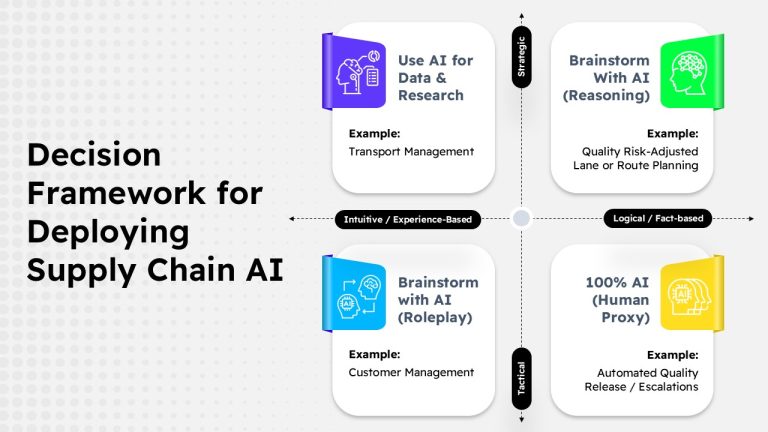
Supply Chain AI is often misunderstood as an automation engine. While AI can automate tasks, its true value lies in its ability to support a full spectrum of decisions—from tactical actions to long-term strategic planning.
In this article and video, we explore how Fortune 500 & Global 2000 organizations can use a simple four-quadrant framework to understand which decisions AI should automate, which decisions AI should support through brainstorming, and which decisions should remain entirely human-led.
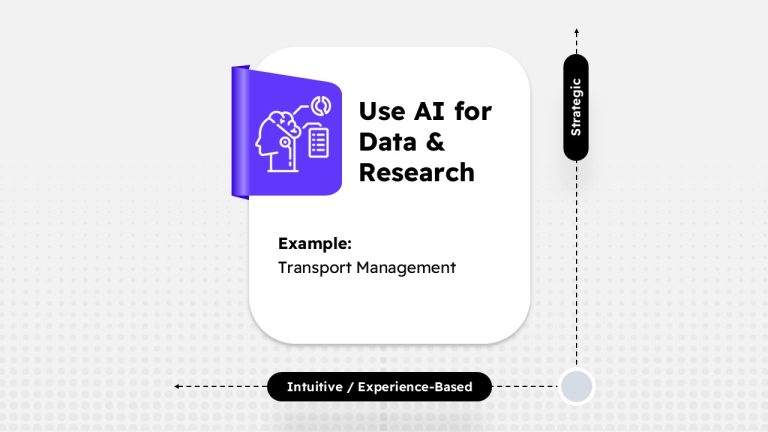
To understand where AI delivers the highest impact, decisions can be mapped across two dimensions:
This creates four decision categories, each requiring a different approach when using AI.
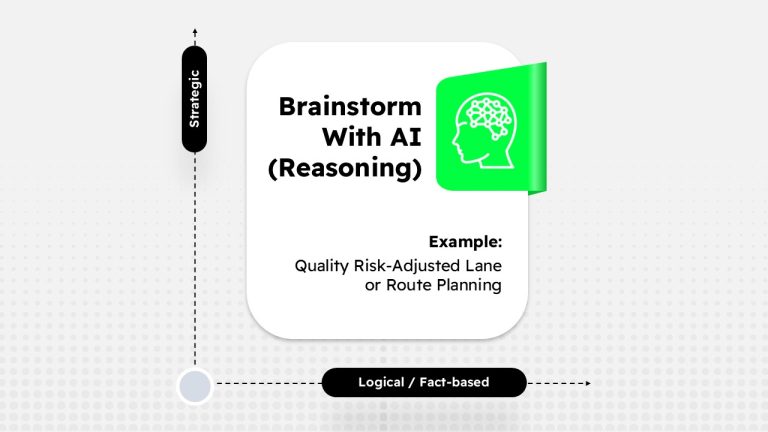
Strategic logical decisions include long-range planning activities such as operational risk planning, quality risk planning, or evaluating a new export lane. These decisions require understanding lane resilience, geopolitical shifts such as tariffs, and upstream risk.
In this category, AI is not used for automation. Instead, teams brainstorm with the system:
AI acts as a partner or co-pilot to explore scenarios, ask follow-up questions, and pressure-test assumptions.
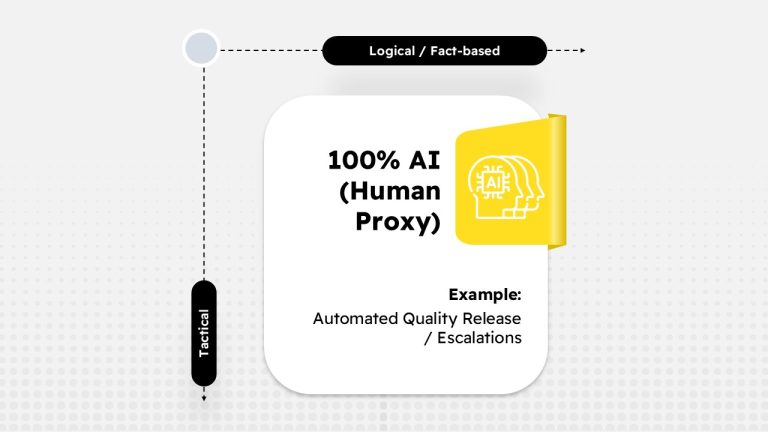
Tactical logical decisions represent the day-to-day tasks that follow clear rules, such as quality release, routine escalations, and repetitive checks.
Here, AI can operate as full automation—a true human proxy—because the logic is structured and repeatable with minimal room for error without human-in-loop.
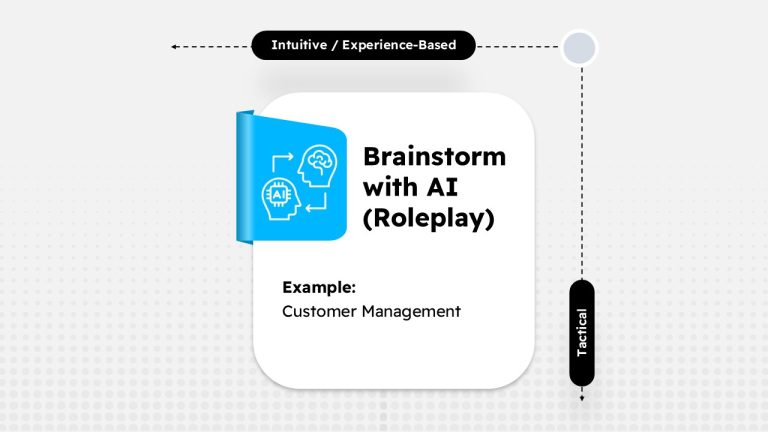
These decisions rely heavily on human context and experience. Customer management is a key example, as each customer has unique expectations and priorities. A delay that is insignificant to one customer may be critical to another.
AI supports this category through role-play and scenario exploration:
AI helps teams think through the customer’s impact before communication, ensuring responses remain proactive and tailored.
These are high-stakes, relationship-driven decisions involving long-term carriers, suppliers, or partners. They influence tenders, quarterly reviews, and annual evaluations. Because of their strategic and relational nature, these decisions remain human-led.
AI’s role here is not to brainstorm or automate. Instead, it provides a strong research foundation by:
AI strengthens the groundwork, so teams enter strategic conversations better prepared.
AI cannot completely replace human reasoning today—but it can amplify it. By applying the right AI method to the right decision type, organizations gain clarity on what to automate, what to co-create with AI, and what to reserve for human expertise. This approach increases planning confidence, enhances execution, and reduces repetitive operational work.
Request a personalized demo to see how real-time visibility and Decision AI power faster, smarter supply chain decisions.

Premsai Sainathan (Prem) is the Vice President of Growth at Decklar, responsible for accelerating the company’s business through scalable demand generation, marketing, branding, communications, and revenue enablement. With over 12 years of entrepreneurial experience, Prem helped Decklar launch its offerings across key markets, establishing early product-market fit, setting up revenue teams, and creating repeatable go-to-market strategies. Prior to Decklar, Prem co-founded and successfully built Skope Solutions, an IoT-enabled indoor positioning solutions firm serving manufacturing, supply chain, and healthcare sectors. He has also contributed to the Laser Interferometer Gravitational-Wave Observatory (LIGO), backed by the National Science Foundation (NSF). Prem holds a Master of Science in Mechanical Engineering from the University of Florida, USA and is a published author and speaker in various industry publications and events.
Michael, through his company CABOA GmbH, is a senior executive advisor to DTCP’s Growth Equity business with more than 20 years of international experience in venture and growth capital, and private equity. In total, he has been responsible for funds with a volume of up to €750 million, invested in more than 40 start-up companies worldwide, and realized more than 30 successful exits. He supports companies mainly in questions of incorporation, funding, and exit – with a special focus on Europe, the USA, and Israel. He speaks the language of investors, start-ups and large to medium-sized companies and ensures sustainable success with his entrepreneurial thinking and acting.
Prior to his current role, Michael was Managing Director in DTCP’s Europe-based growth capital team and before that, Managing Director at T-Venture where he focused on disruptive wireless, deep-tech, and infrastructure investments. Earlier in his career, he worked as Senior Consultant at Detecon International, as Product Manager of the German fixed network operator o.tel.o Communications, and founded his own company.
Michael holds an M.Sc. in Economics from the University of Wuppertal, Germany.
Meenakshi Singh is a Silicon Valley veteran with more than 30 years of experience in corporate finance, leadership, and management, mergers and acquisitions. She has been through a merger or acquisition 15+ times and has the unique ability to be able to view the exit strategy from both sides of the table. In her role as Decklar’s CFO and Board member, she oversees financial operations of Decklar and its foreign operations.
Meenakshi was the founding CFO of many technology companies including Apigee (NASDAQ: APIC), Cortina Systems, (acquired by Inphi Corporation), Ankeena Networks (acquired by Juniper Networks) and StratumOne, acquired by Cisco Systems and where she was an executive in the Mergers & Acquisitions team.
Crystal is a Principal at Reefknot Investments, a Venture Capital fund focused on investing in Supply Chain and Logistics technology startups globally.
Crystal brings over 10 years of investing experience executing VC/PE, M&A, JV and Greenfield investments globally across diverse industry sectors, including transportation, logistics, financials and food/natural resources. She was formerly with the global M&A team at Louis Dreyfus Company with a focus on Asia and Middle East / Africa deals. Crystal was also previously with Momentum Ventures, the corporate venture arm of a leading transport operator, overseeing investments and facilitating the adoption of innovative technology and business models within the corporate.
Crystal also serves on the Singapore Venture & Private Capital Association (SVCA) VC Sub-committee.
George is a distinguished leader in the finance and business community in Silicon Valley and the broader United States, with over 35 years of experience. He has held pivotal roles such as COO, CFO, and CEO at renowned organizations, including Pluribus Networks, Marvell Technology, Chordiant Software, Remedy Corporation, and Aeroprise, Inc. He has navigated an impressive track record of IPOs, substantial M&A deals, and capital-raising ventures, amounting to over $½ billion.
Starting his career as a CPA in the big-four accounting industry followed by subsequent executive roles, George possesses extensive board experience, notably as Chair of the Audit Committees at Bridgelux, Inc., Vendavo, Inc., Saba Software, Inc., GCT Semi, Inc., Rainmaker Systems, Inc., and Montalvo Arts Center. George was also appointed a member of President George Bush’s National Information Technology Advisory Committee. Currently, he serves as a Director of HeartBeam, Inc., a publicly traded medical device company, where he chairs the Audit Committee and is a member of the Compensation Committee.
George’s career highlights include his tenure as CFO for Remedy Corporation, which was recognized as the “#1 Hot Growth Company” in America by Business Week. He has spoken at Forbes magazine’s annual CFO conference, authored multiple articles, and been featured in The Wall Street Journal’s “CFO Journal.” He has delivered guest lectures at prestigious institutions like the University of California at Berkeley, Cambridge University in the UK, and Baylor University.
George holds a Master of Business Administration from the University of California at Berkeley and a Bachelor of Science in Accounting/Business from the University of Southern California.
Dweep has over 10 years of experience advising or investing into companies across the growth cycle in Industrial IoT, financial services, energy and consumer sectors in US, Europe, and Asia.
He was previously Head of Venture Investments at Momenta Partners, where he led 7 industrial IoT investments. Previously he was Managing Director at Touchstone Ventures, a direct investment firm advising family offices on growth-stage investments, served as Director, Strategy and Business Development for Family Services at UBS Wealth Management, and led a UN financed market entry and financing program in Kenya.
A telecommunications engineer by training, he worked for over 6 years with Lucent and Hughes. He has worked in India, USA, Kenya, and China, and is currently based in Switzerland.
Deepak is a Senior Investment Manager at Qualcomm Ventures focusing on US investments. He is responsible for sourcing, deal execution and portfolio management. He brings 5+ years of investment experience across early to growth stage companies, combining his tech background with his passion for investing.
Before joining Qualcomm Ventures, Deepak was part of the founding team at the GPO Fund, NY based tech-focused investment firm, where he led several enterprise tech investments such as MapAnything (acquired by Salesforce). Prior to this role, he worked at Unilazer Ventures, investing in several successful consumer tech companies such as Lenskart. He has also worked at The Carlyle Group and Soros Fund Management as part of their investment team.
Deepak earned his MBA from Columbia Business School and a Bachelor of Technology in Computer Engineering from VJTI, Mumbai.
As the Regional Vice President for India, the Middle East, and Africa (IMEA) at Decklar, he drives regional business development, enhances customer experience, and ensures operational excellence to expand our presence across key markets. His focus is on leveraging Decklar’s cutting-edge supply chain visibility and intelligence solutions to help businesses optimize operations, improve efficiency, and gain real-time actionable insights.
With over 15 years of experience in logistics, product management, and sales, he has a proven track record of leading large-scale business transformations, managing multi-million-dollar P&L portfolios, and driving strategic expansion initiatives. Prior to joining Decklar, he served as the Global Head of Growth, Strategy, and Solution Design at Maersk, where he played a pivotal role in expanding the company’s global warehousing footprint, driving M&A efforts, and spearheading strategic sales initiatives.
At Maersk, Nitesh had extensive experience in customer acquisition and key account management across Retail, Lifestyle, FMCG, Technology, and Chemical verticals. He served as a trusted advisor and key point of contact for strategic clients, helping them optimize their supply chains by leveraging Maersk’s suite of logistics services, including warehousing, transportation, and integrated supply chain solutions. Through these engagements, he helped strengthen long-term partnerships, drive multimillion-dollar revenue growth, and expand market share in high-potential industries.
Before joining Maersk, he gained hands-on experience in logistics and supply chain operations across India and Europe, working in transportation, warehousing, and end-to-end supply chain management. This operational background has given him a strong foundation in process optimization, operational efficiency, and logistics execution, which he has successfully leveraged in his leadership roles to drive strategic growth and transformation. Additionally, his expertise in supply chain digitization, predictive analytics, and automation has helped businesses improve efficiency, resilience, and scalability.
Nitesh holds a Master’s in Logistics and Supply Chain Management from Lancaster University, along with Certified in Logistics, Transportation, and Distribution (CLTD) and Certified Supply Chain Professional (CSCP) credentials from APICS. These qualifications reinforce his expertise in supply chain strategy, operational excellence, and industry best practices, enabling him to drive impactful results in logistics and transformation.
At Decklar, his vision is to empower businesses with real-time supply chain intelligence, optimize operational efficiencies, and accelerate digital transformation across the IMEA region. By leveraging Decklar’s advanced AI-driven solutions, he aims to help businesses reduce risks, enhance visibility, and build more resilient supply chains for the future.
Pankaj Patel is the Chief Scientist and Vice President of IoT Research and Development for Decklar. In this role, he is responsible for leading new product innovations, solutions, and IP for a broad range of IoT applications.
Before Decklar, Pankaj was Founder, Lead Researcher and Chief Technologist at IntelliSys. For more than thirty years, he has focused on developing key technology and IP, then taking it into the market as successful external ventures and partnerships. These included three security products companies sold to Ademco (a division of Honeywell). In addition to Ademco, other key technologies were developed/licensed to Fortune 500 companies like Panametrics (GE & Olympus), Emerging Market Communications (Global Eagle Entertainment) and Aware Inc. Pankaj worked at Panametrics in a variety of leadership and scientific capacities and was critical in making Panametrics #2 in the world. He was the Founder and CTO of Biometrics fingerprint security company that had an IPO. Recently, he was instrumental to two Silicon Valley start-ups, RiskVision and Aceurity, in developing their key technology, solutions, and teams.
Pankaj holds Masters Electronics Engineering from Worcester Polytechnic Institute, Massachusetts, a Bachelors degree in Electrical Electronics from Sardar Patel University, India, and is GE Six Sigma for Software.
As Vice President of Growth at Decklar, Premsai Sainathan (Prem) is responsible for accelerating the company’s business through scalable and sustainable demand generation, branding, marketing, communications, and revenue enablement.
Prem brings 12+ years of entrepreneurial and global business growth experience; he helped Decklar launch its offering in several of its currently flourishing markets by establishing early product-market fit, setting up revenue teams, and templatizing go-to-market (GTM) strategies for repeatability.
Before Decklar, he co-founded and successfully built Skope Solutions, an Internet of Things (IoT)-enabled indoor positioning solutions firm focused on manufacturing, supply chain, and healthcare applications in the United States. He’s also worked with the Laser Interferometer Gravitational-Wave Observatory (LIGO), backed by the National Science Foundation (NSF).
Prem is a published author and speaker with features and keynotes in Supply Chain Digital, Supply Chain Brain, Modern Materials Handling, Cargo Connect, Confederation of Indian Industry (CII), Global Logistics Show, and more.
He has a Master of Science (MS) in Mechanical Engineering from the University of Florida, USA.
An energetic leader and results-driven executive with over 15 years of solution delivery experience, was featured in the list of ‘Supply Chain Pros to Know’ published by Supply Chain & Demand Chain Executive.
At Decklar, he is responsible for bringing emerging technologies in hardware, communication, data, and analytics to enable and optimize digital supply chains.
Before Decklar, Vidya was Co-Founder and VP Professional Services at KeyTone Technologies Inc., a RFID technology company focused on providing a technology-enabled service for real-time asset monitoring through an enterprise scale sensor-based platform. Global Asset Tracking UK Ltd successfully acquired KeyTone. He has also held influential and leadership roles at Plexus Technologies Inc., KPMG Consulting, Unisys, and PriceWaterhouseCoopers (PwC).
Vidya holds a Masters in Computer Science from Temple University and dual Bachelor’s degrees in Computer Science and Economics from Calvin College, Michigan.
Shailesh Mangal is Decklar’s Vice President of Engineering. He is responsible for the ensuring excellence in the development, performance, and quality all Decklar platforms and applications.
Shailesh has been developing enterprise and web applications for more than 20 years. His passion spans from nurturing highly productive and agile development teams to steering through fast-paced ever-changing development landscapes and maintaining code quality & performance. His main areas of interest include object-oriented design, system and cloud architectures, big data, real-time search, and analytics.
Shailesh holds a Masters in IT from The University of Texas and a Bachelors in Engineering from MNIT, Jaipur, India.
Jigna Yagnik is a growth-focused finance leader with a track record of building financial systems that scale with the business. As Vice President of Finance at Decklar, she plays a pivotal role in shaping the company’s strategic direction through data-driven financial planning, operational rigor, and investor-ready governance.
Jigna is a finance professional with over 15 years of varied experience in corporate finance, strategy, planning, budgeting, financial modelling, and compliance.
Prior to Decklar, Jigna led teams in finance and operations at PwC Strategy (Booz & Co) and Novasys. She led mergers & acquisitions (M&As), optimized working capital, brought in structure, and developed operating models. She played a key role in formulating and driving strategy by leading various business discussions that impacted P&L.
Jigna is a Chartered Accountant, a Chartered Finance Analyst (USA), and holds an MBA in Finance and Strategy from the Indian School of Business at Hyderabad, India.
With extensive experience providing legal and business guidance to technology, cloud, software and service companies in outside and in-house positions, Frank I. Hoppe serves as Decklar’s General Counsel. He is responsible for all aspects of Decklar’s expanding global legal endeavors. Before Decklar, Frank served as Executive Vice President and General Counsel of Kaseya; President and founding member of Hoppe General Counsel Services; Vice President and Assistant General Counsel at West Corporation, and Vice President of Corporate Development at uRoam, Inc. which was acquired by F5 Networks, Inc. He also previously worked as associate counsel at the law firm Wilson Sonsini Goodrich and Rosati, and the law firm Krieg, Keller, Sloan, Reilley & Roman.
In addition to his J.D. from UC Berkeley Boalt Hall School of Law, he received his B.A., with distinction, as an Echols Scholar from the University of Virginia where he served as Chairman of the University’s student-run Judiciary Committee.
As Vice President of Global Operations at Decklar, Pratik Soni is responsible for operational excellence and leading the strategic, multinational expansion of the company’s operational infrastructure and capabilities to enable business growth at scale.
Pratik has over 20 years of experience as an Operating Executive with subject-matter-expertise in global supply chain and operations management. He is a multi-published author and highly regarded industry thought leader with inventorship of foundational technology patents and trade secrets enabling digital transformations across industries.
Pratik’s career spans leadership roles across superior companies like 20th Century Fox, Beats by Dre, I.am.+, Apple and Omnichain. Most notably, he led Omnichain, a venture-funded supply chain SaaS startup, as its Founder and CEO, where he successfully launched & scaled autonomous supply chain technology solutions from procurement to delivery through Omnichain’s Cloud platform. He’s not just a strategist but also a player-coach, empowering cross-functional teams to achieve operational excellence.
Pratik has a Bachelor of Science in Business Information Systems and Global Supply Chain & Operations and advanced Certifications in Lean Sig Sigma – Continuous Improvement, CSCP and CPIM.
Dave Ferretti is an enterprise systems and software sales leader for first-mover disruptive technologies in artificial intelligence/machine learning-based data science solutions for Global 2000 markets. As Vice President of Sales for Americas at Decklar, he is responsible for predictably accelerating the company’s revenues and scaling customer acquisition and account expansion efforts.
Dave began his sales career at Xerox; he then successfully built and scaled sales for five technology startups acquired by Fortune 500 companies such as HPE, Western Digital, Microsoft, IBM, and EMC. He has hands-on design and deployment experience with software systems engineering, delivering innovative end-to-end hardware/software solutions. He has held the highest level of US federal government security clearances.
Dave has a Bachelor of Science in Computer Information Systems/Business Administration from the University of Colorado, Boulder.
Sanjay Sharma is a strategic thought leader with an impressive 17+ years of entrepreneurial experience building technology start-ups from the ground up. As CEO of Decklar, he is responsible for leading the company’s vision, driving its worldwide business growth, and increasing Decklar’s value.
He is also a renowned speaker and featured author on topics like supply chain, disruptive technologies, and digitization. He has delivered engaging talks around the world at prestigious platforms like Mobile World Congress, TiE, Global Digital Forum, Geo IoT World, Logipharma, Red at Summit, IoT Evolution Expo, International Smart Logistics & Supply Chain Conference, and DHL IoT Day.
Sanjay has successfully co-founded and led two successful Silicon Valley companies: KeyTone Technologies and Plexus Technologies, with successful exits. Prior to that, he was an innovator through his technology careers at NASA, EMC, and Schlumberger. He holds many patents and has published papers in journals like IEEE, ISCA, and South Dakota Academy of Science.
Sanjay has a Master of Science in Electrical Engineering from South Dakota State University and a Bachelor’s Degree in Electronics Engineering from the University of Bombay.